


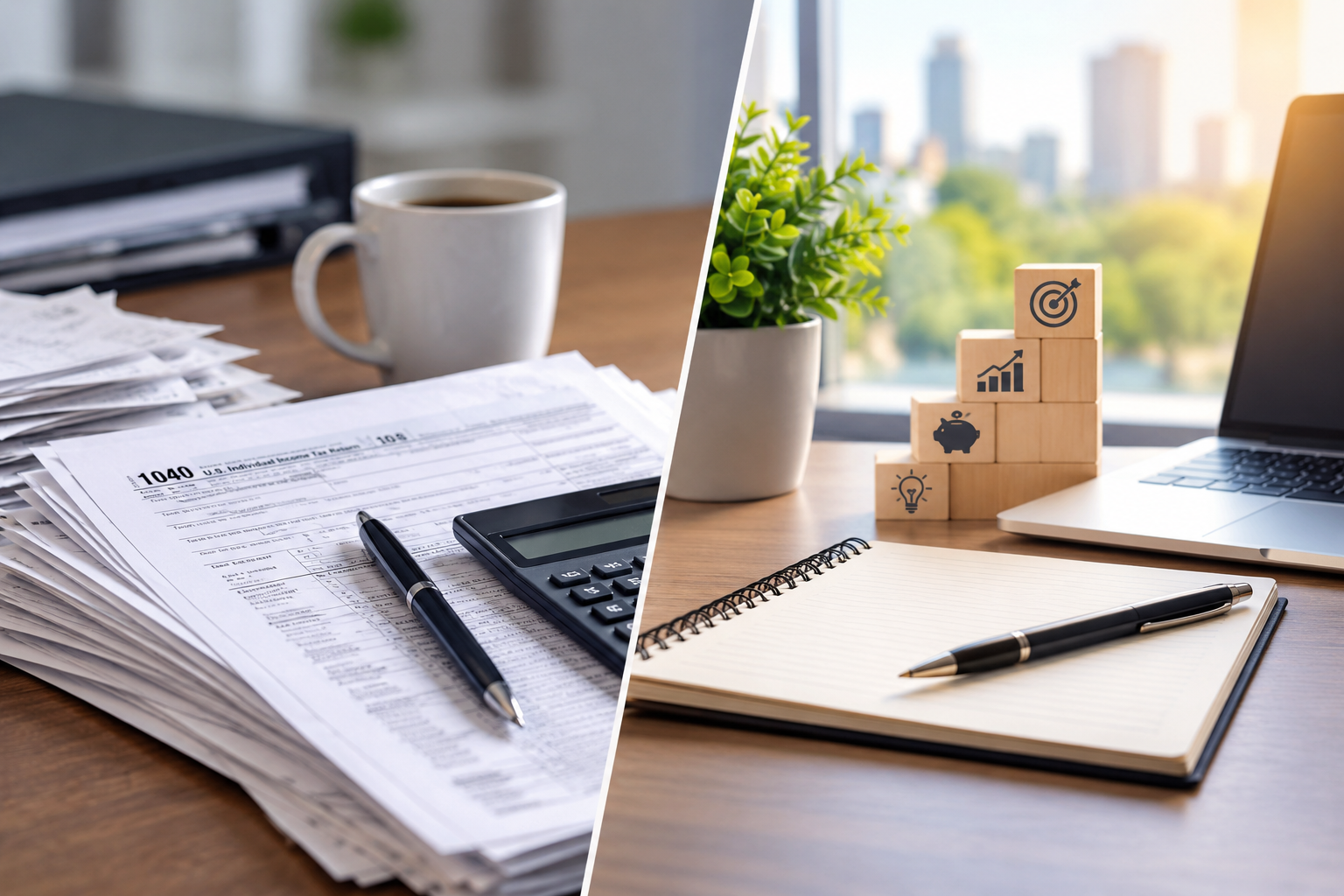
Tax preparation and tax planning are terms that are often used interchangeably, but they describe two very different parts of managing your taxes. Understanding the difference can help individuals and business owners make better financial decisions, avoid unexpected tax bills, and potentially identify opportunities to reduce their overall tax burden.
The simplest way to think about it is this: tax preparation looks backward, while tax planning looks forward.
Tax preparation focuses on accurately reporting financial activity that has already happened. Tax planning takes a proactive approach by reviewing your current financial situation and considering decisions that could affect future taxes.
Both are important. However, relying only on tax preparation can mean missing opportunities that needed to be addressed months before your return was due.
In this guide, we’ll explain the difference between tax preparation vs. tax planning, when each service is needed, and why a year-round approach can be especially valuable for individuals and business owners.
What Is Tax Preparation?
Tax preparation is the process of gathering financial information, calculating tax obligations, completing required tax forms, and filing returns with the appropriate tax authorities.
Most people associate tax preparation with the traditional tax season.
For an individual, tax preparation may involve reviewing documents such as:
- W-2 forms
- 1099 forms
- Investment statements
- Mortgage interest statements
- Retirement contribution records
- Charitable contribution records
- Estimated tax payments
- Other relevant income and deduction information
For businesses, the process can be more complicated. Business tax preparation may require financial statements, payroll records, contractor information, asset purchases, depreciation schedules, and other accounting records.
The primary objective is to accurately report what happened during the tax year.
What Does a Tax Preparer Do?
A tax professional preparing a return typically reviews the taxpayer’s financial records, determines which forms are required, calculates taxable income, applies applicable deductions and credits, and prepares the return for filing.
A tax preparer may also identify errors or missing information before the return is submitted.
For example, a preparer might notice that a business’s bookkeeping records do not match its bank statements or that an individual appears to be missing a tax document.
However, there is an important limitation: by tax preparation time, the year being reported has usually already ended.
That means some potential planning opportunities may no longer be available.
What Is Tax Planning?
Tax planning is a proactive process that examines how financial decisions may affect your future tax liability.
Instead of waiting until tax season, tax planning typically occurs throughout the year.
A tax planning review may consider areas such as:
- Current and projected income
- Business profits and expenses
- Estimated tax payments
- Payroll and compensation
- Retirement contributions
- Investment transactions
- Major asset purchases
- Business structure
- Charitable giving
- Real estate transactions
- Potential deductions and credits
The goal is to understand potential tax consequences before important decisions are finalized whenever possible.
Tax Preparation vs. Tax Planning: The Main Difference
Consider a small business owner who purchases expensive equipment.
During tax preparation, the tax professional reviews the purchase, determines the applicable tax treatment, and reports it correctly on the return.
Tax planning would happen earlier.
Before making the purchase, the business owner and tax professional could discuss issues such as timing, cash flow, depreciation treatment, and how the purchase fits into the company’s broader financial strategy.
Another example involves a self-employed professional whose income increases substantially during the year.
If the issue isn’t discovered until tax preparation, the taxpayer may face a larger balance due than expected.
With year-round tax planning, income could be reviewed earlier and estimated tax payments could potentially be adjusted.
This illustrates the fundamental difference: preparation reports the outcome; planning can help you prepare for the outcome.
Why Tax Preparation Is Still Essential
Tax planning does not replace tax preparation.
Accurate preparation remains essential for complying with tax requirements and properly reporting income, expenses, deductions, credits, and other relevant financial activity.
Good tax preparation can help:
- Reduce filing errors
- Identify missing documents
- Properly report income
- Claim eligible deductions and credits
- Maintain accurate tax records
- Meet filing requirements
- Respond more effectively if questions arise later
For businesses, accurate tax preparation also depends heavily on good bookkeeping.
If financial records are incomplete or inaccurate, preparing a reliable business tax return becomes much more difficult.
Why Tax Planning Should Happen Throughout the Year
Many tax decisions have deadlines.
Waiting until tax season may mean discovering an opportunity after the deadline has already passed.
Year-round tax planning provides time to evaluate potential strategies before making decisions.
For example, a business owner might review profitability during the third or fourth quarter rather than waiting until the following spring.
That review could lead to discussions about estimated payments, retirement planning, equipment needs, payroll, or other business decisions.
The purpose isn’t to make financial decisions solely for tax reasons. Instead, tax considerations become one part of a broader financial decision-making process.
Tax Planning for Business Owners
Business owners often have more opportunities—and more responsibilities—than traditional W-2 employees.
Their tax situation may be affected by:
- Business structure
- Payroll
- Owner compensation
- Employee benefits
- Equipment purchases
- Business vehicles
- Retirement plans
- Estimated taxes
- Contractor payments
- Business expansion
- Selling business assets
A company’s tax strategy may also need to change as the business grows.
For example, the entity structure that made sense when a company generated modest revenue may need to be reviewed as profits, payroll, and the number of employees increase.
Regular tax planning provides an opportunity to evaluate whether the current approach still fits the business.
Tax Planning for Self-Employed Professionals
Freelancers, consultants, independent contractors, and other self-employed professionals frequently have income without traditional payroll withholding.
That can make estimated tax planning especially important.
A self-employed professional may need to monitor:
- Quarterly estimated payments
- Business deductions
- Self-employment taxes
- Retirement contributions
- Health insurance expenses
- Business equipment
- Home office expenses when applicable
If income fluctuates significantly, estimates made at the beginning of the year may no longer reflect the taxpayer’s actual situation.
Periodic reviews can help identify those changes earlier.
Tax Planning for Individuals
Tax planning isn’t only for businesses or high-income taxpayers.
Individuals may also benefit from planning when they experience significant financial or personal changes.
Examples include:
- Changing jobs
- Receiving a large bonus
- Getting married
- Getting divorced
- Having a child
- Buying or selling a home
- Selling investments
- Receiving significant investment income
- Starting a side business
- Approaching retirement
Each of these events can affect taxes differently.
Discussing the potential tax impact before or shortly after a major change can provide more time to prepare.
The Role of Bookkeeping in Tax Planning
For business owners, effective tax planning requires reliable financial information.
If your books are six months behind, it is difficult to know how much profit the company has generated or estimate its year-end position.
Clean bookkeeping allows a tax professional to review current information such as:
- Revenue
- Expenses
- Net profit
- Payroll
- Assets
- Liabilities
- Estimated tax payments
This is one reason bookkeeping, tax preparation, and tax planning should work together.
Accurate books provide the information. Tax planning uses that information to look ahead. Tax preparation uses the final records to prepare the return.
Common Mistakes Taxpayers Make
One of the biggest mistakes is assuming that receiving a refund automatically means your tax strategy is working well.
A refund generally means more tax was paid during the year than the final tax liability required, although refundable credits and other circumstances can also affect the result.
Likewise, owing money when filing doesn’t automatically mean something went wrong.
The more useful question is whether the result was expected and whether your tax payments and financial decisions were managed appropriately throughout the year.
Other common mistakes include:
- Waiting until tax season to ask planning questions
- Failing to update estimated payments after income changes
- Making major financial decisions without considering taxes
- Allowing bookkeeping to fall behind
- Missing documentation for legitimate expenses
- Assuming last year’s strategy will automatically work this year
Tax circumstances change, which is why periodic reviews can be valuable.
When Should You Schedule a Tax Planning Review?
There is no single schedule that works for everyone.
However, tax planning can be particularly helpful:
- Early in the year
- After a major income change
- Before making a significant business purchase
- Before selling investments or business assets
- When starting or expanding a business
- Before retirement
- During the third or fourth quarter
- Before year-end planning deadlines
Business owners with rapidly changing income may benefit from more frequent reviews.
Tax Preparation and Tax Planning Work Best Together
It shouldn’t be a choice between tax preparation and tax planning.
The strongest approach connects the two.
Your previous tax return provides valuable information that can help guide future planning. Throughout the year, current financial records can then be reviewed to identify changes and potential issues. When tax season arrives, organized records and proactive planning can make preparation more straightforward.
This creates a cycle:
Accurate bookkeeping → proactive tax planning → organized tax preparation → better information for next year’s planning.
Instead of treating taxes as a once-a-year event, you begin managing them as part of your overall financial strategy.
Final Thoughts: Be Proactive About Your Taxes
Understanding tax preparation vs. tax planning can change the way you approach your finances.
Tax preparation is necessary for accurately reporting the past. Tax planning helps you look toward the future and understand the potential tax consequences of decisions before valuable opportunities or deadlines pass.
For individuals, self-employed professionals, and business owners, combining both services can provide greater clarity throughout the year and reduce the chance of unpleasant surprises during tax season.
At Tax Alternatives, we help clients move beyond simply preparing tax returns. Our goal is to help individuals and businesses maintain organized financial information, understand their tax obligations, and take a more proactive approach to tax planning.
Want to stop waiting until tax season to think about your taxes? Fill out the form below to contact Tax Alternatives and learn how year-round tax preparation and tax planning support can help you stay organized and better prepared.